
22 October 2026 · Saify Advance Materials
FR4 vs G10 Glass Epoxy Sheets: Key Differences
FR4 and G10 are glass-reinforced epoxy sheets widely used for electrical insulation and industrial applications. While both offer excellent electrical insulation and mechanical strength, their key difference lies in flame retardancy. Learn how FR4 and G10 compare in terms of properties, applications and performance, and how to choose the right grade for your requirements.
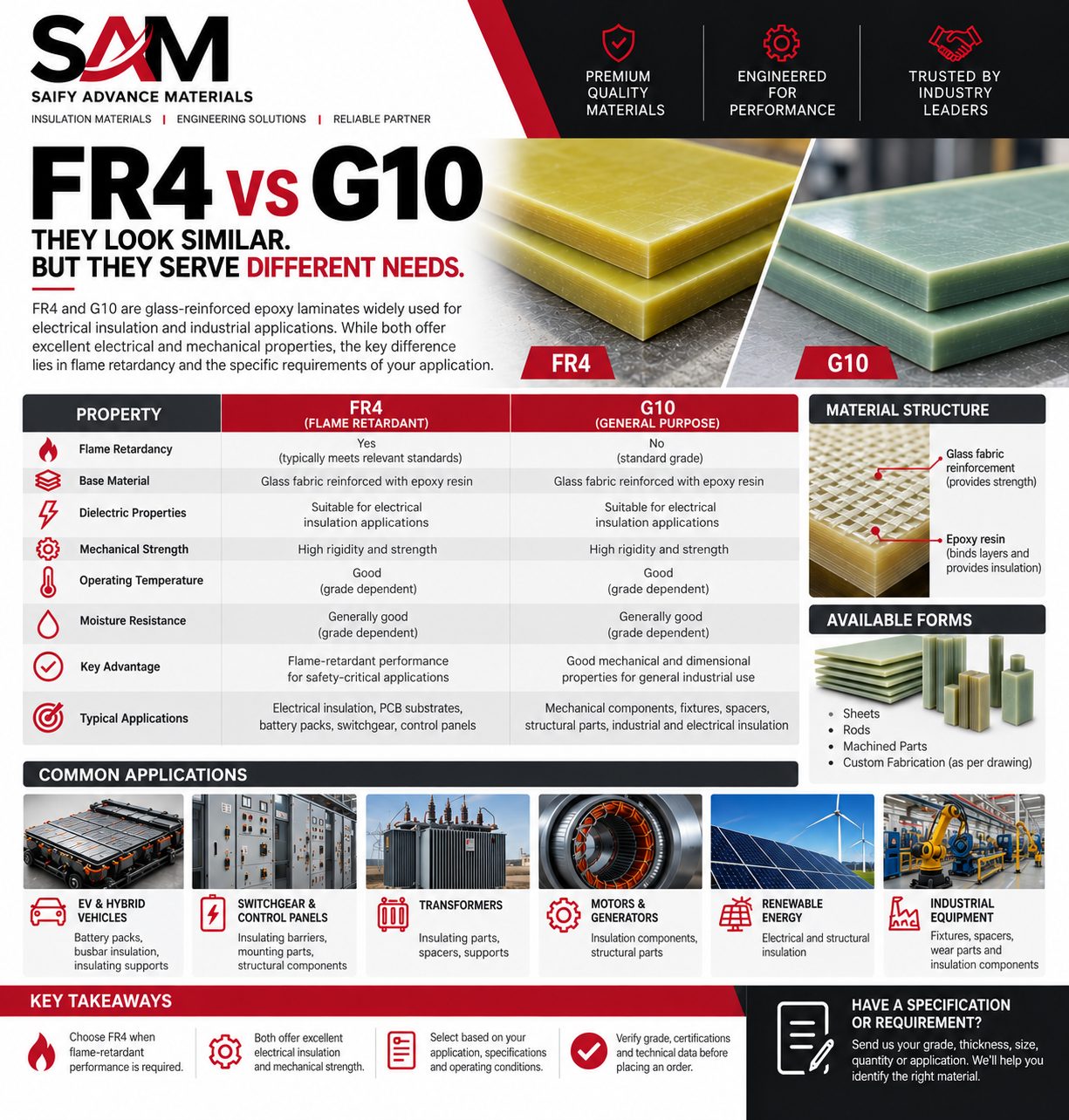
FR4 vs G10 Glass Epoxy Sheets: Differences, Properties and Industrial Applications
FR4 and G10 are glass-reinforced epoxy laminates widely used in electrical insulation, industrial equipment and precision-machined components. Although both materials share a similar base construction, their flame-retardant characteristics can make a significant difference when selecting the right grade for an application.
For electrical panel manufacturers, EV component suppliers, transformer manufacturers and industrial fabricators, choosing between FR4 and G10 requires more than comparing prices or colours. Dielectric performance, mechanical loading, operating temperature, material thickness and applicable safety specifications all need to be considered.
In this guide, Saify Advance Materials explains the technical differences between FR4 and G10 glass epoxy sheets, their applications and the key factors to evaluate before sourcing either material.
What Are FR4 and G10 Glass Epoxy Laminates?
FR4 and G10 are rigid composite materials manufactured using woven glass fabric impregnated with epoxy resin. The laminate is consolidated under controlled heat and pressure to produce a sheet with electrical insulating properties and mechanical rigidity.
The glass reinforcement contributes to the material's strength and dimensional stability, while the epoxy resin binds the layers and provides the matrix for the composite.
Both grades are used to manufacture insulating barriers, spacers, support plates, fixtures and other components that require a combination of electrical insulation and mechanical performance.
The principal distinction is flame retardancy. FR4 is formulated for flame-retardant performance, whereas standard G10 is generally supplied without the same flame-retardant classification.
FR4 vs G10: Technical Comparison
| Property | FR4 Glass Epoxy | G10 Glass Epoxy |
|---|---|---|
| Base construction | Woven glass fabric and epoxy resin | Woven glass fabric and epoxy resin |
| Flame-retardant performance | Formulated to meet specified flame-retardancy requirements | Standard grade is generally non-flame-retardant |
| Dielectric properties | Suitable for many electrical insulation applications | Suitable for many electrical insulation applications |
| Mechanical performance | High rigidity and strength | High rigidity and strength |
| Dimensional stability | Generally good | Generally good |
| Moisture absorption | Depends on grade, thickness and test conditions | Depends on grade, thickness and test conditions |
| Thermal performance | Depends on the specified grade and operating conditions | Depends on the specified grade and operating conditions |
| Typical applications | Electrical insulation, PCB substrates, insulating barriers and structural components | Machined parts, fixtures, spacers and general-purpose insulating components |
| Main selection criterion | Applications requiring specified flame-retardant performance | Applications where standard G10 meets the design requirements |
Technical note: FR4 and G10 are material designations, not guarantees that every manufacturer's product has identical properties. Verify the datasheet, applicable test methods and certifications for the exact grade being supplied.
1. Flame Retardancy: The Key Difference Between FR4 and G10
The most important distinction between standard FR4 and G10 is their specified flame-retardant performance.
FR4 grades are formulated to meet flame-retardancy requirements. Some commonly available grades carry a UL 94 V-0 classification, but this must be verified for the particular product and its supporting certification.
Standard G10 is generally not supplied with the same flame-retardant classification.
This distinction matters when a material is used in electrical equipment where fire-related requirements form part of the design specification, customer approval or applicable safety standard.
For example, an electrical panel manufacturer specifying a flame-retardant insulating barrier should not substitute standard G10 simply because its dimensions and appearance are similar to FR4. The replacement must meet the same relevant requirements and receive the necessary design approval.
When to consider FR4: When the application requires a specified flame-retardant grade, subject to verification of the product's classification and documentation.
When to consider G10: When standard G10 meets the mechanical, electrical and environmental requirements and the application does not require a different flame-retardancy classification.
Flame-retardant properties of the sheet should not be confused with the fire safety of the complete assembly.
2. Dielectric Strength and Electrical Insulation
Both FR4 and G10 are used in applications requiring electrical insulation. However, dielectric strength alone is not sufficient to determine whether a sheet is suitable for a particular electrical assembly.
Dielectric strength is typically expressed in kilovolts per millimetre (kV/mm). The measured value depends on factors such as the laminate construction, specimen thickness, test method, conditioning and test environment.
Other considerations include:
- Operating voltage and the required insulation thickness
- Electrical frequency and relevant dielectric properties
- Creepage and clearance requirements in the finished assembly
- Temperature and humidity exposure
- The geometry and fabrication quality of the finished component
For example, an insulating support inside a control panel may have different design requirements from a component used in a higher-voltage power system.
The appropriate grade should therefore be selected using the equipment specification and the manufacturer's verified technical data rather than a generic dielectric-strength figure.
3. Mechanical Strength and Machining Performance
Glass epoxy sheets are commonly selected where rigid, dimensionally stable insulating components are required.
Depending on the design, FR4 and G10 can be machined into:
- Insulating spacers and mounting plates
- Electrical support components
- Fixtures and positioning parts
- Rigid insulating barriers
- Custom components manufactured to engineering drawings
When comparing materials, consider flexural strength, tensile strength, compressive performance, impact resistance and dimensional tolerances where relevant.
It is not accurate to state that G10 is always mechanically stronger than FR4. Their performance can overlap, and the actual comparison depends on the specific laminate, thickness, construction and test conditions.
Machining requirements also matter. Hole positions, edge quality, tolerances and component geometry should be considered when specifying sheets for fabrication.
4. Thermal Performance and Environmental Resistance
Operating temperature is another important consideration when specifying a glass epoxy laminate.
The material's thermal performance depends on its resin system, grade and intended operating conditions. A temperature value quoted for short-term exposure should not automatically be treated as a continuous operating-temperature rating.
Similarly, both materials generally provide useful dimensional stability and moisture resistance, but their performance can change with prolonged exposure to humidity, chemicals or elevated temperatures.
Before selecting a grade, establish:
- The expected continuous and peak operating temperatures
- Exposure to moisture and humidity
- Contact with oils, chemicals or process fluids
- Mechanical loading during operation
- Any required thermal, electrical or environmental certification
For critical applications, request the appropriate technical datasheet and confirm that the specified material is suitable for the actual operating environment.
Applications of FR4 and G10 Glass Epoxy Sheets
Electrical Switchgear and Control Panels
Glass epoxy laminates can be fabricated into insulating barriers, support plates, spacers and mounting components used in electrical assemblies. Where flame-retardant performance is required, the specified grade and certification must be verified.
EV Battery Packs and Battery Energy Storage Systems
Selected glass epoxy components can be used for insulation and support in battery-related equipment. Material selection should account for electrical insulation, mechanical loading, temperature exposure and the system's fire-safety requirements.
The suitability of a laminate must be assessed as part of the complete battery design rather than assumed from the material designation alone.
Transformers, Motors and Generators
Glass epoxy laminates can be used in selected insulating supports, spacers and fabricated components for electrical equipment. The final choice depends on the equipment's insulation system, operating conditions and mechanical requirements.
Industrial Fixtures and Precision-Machined Parts
G10 and FR4 are also used for rigid fixtures, mounting components and machined parts where dimensional stability and insulating properties are beneficial.
The required tolerances, thickness, mechanical loads and fabrication method should be specified before the material is ordered.
How to Choose the Right Glass Epoxy Sheet
Before purchasing FR4 or G10, use the following checklist to define your requirements.
1. Material grade: Determine whether FR4, G10 or another specified laminate is required by the drawing or application.
2. Flame-retardancy classification: Establish whether a particular classification, such as UL 94 V-0, is mandatory. Request supporting documentation for the exact grade.
3. Thickness and dimensions: Specify the required thickness, sheet size and dimensional tolerances.
4. Electrical requirements: Identify the operating voltage and the relevant insulation properties required by the design.
5. Mechanical requirements: Consider loading, vibration, machining and dimensional stability.
6. Operating environment: Define the expected temperature, moisture exposure and contact with chemicals.
7. Quantity and documentation: Confirm the required quantity, technical datasheet, certifications and any customer-specific approvals.
Providing this information to your supplier helps identify a suitable material and reduces the risk of ordering a grade that does not meet the application requirements.
Frequently Asked Questions About FR4 and G10
Is FR4 the same as G10?
No. Both are glass fabric reinforced epoxy laminates, but FR4 is formulated for flame-retardant performance. Standard G10 generally does not carry the same flame-retardant classification.
Is FR4 stronger than G10?
Not universally. Both can provide high mechanical strength. The actual performance depends on the specific material grade, laminate construction, thickness and test method.
Can G10 replace FR4?
Only when the application permits it. Standard G10 should not replace a specified flame-retardant grade if that classification is mandatory. Check the relevant specification and obtain approval from the design authority or customer.
Are FR4 and G10 available in different thicknesses?
Yes. Availability depends on the supplier, grade and product range. Include the required thickness, dimensions and quantity when requesting a quotation.
How can I identify a genuine FR4 grade?
Request product identification, the manufacturer's technical datasheet and evidence of any required flame-retardancy classification. Colour alone is not a reliable method of identifying the material grade.
What information should I provide when requesting a quote?
Provide the grade, thickness, sheet dimensions, quantity and intended application. Include any mandatory standards, flame-retardancy requirements or technical drawings to help your supplier assess the requirement.
Source FR4 and G10 Glass Epoxy Sheets from Saify Advance Materials
Saify Advance Materials supplies FR4 and G10 glass epoxy sheets for industrial and electrical insulation applications.
We support OEMs, electrical equipment manufacturers, industrial buyers and fabricators sourcing insulation materials for applications including switchgear, control panels, battery-related equipment, motors and other industrial components.
Our team can assist with enquiries based on your material grade, dimensions, quantity and application requirements.
Looking for FR4 or G10 glass epoxy sheets?
Send us your required grade, thickness, sheet size and quantity to discuss availability and pricing.
Explore our FR4 and G10 glass epoxy sheets or browse the Saify Advance Materials insulation catalogue.