
26 October 2026 · Saify Advance Materials
Thermal Pads for Electronics: Applications, Benefits and How to Choose the Right Material
Learn how thermal pads improve heat transfer and electrical insulation in EVs, BESS, inverters and power electronics. Explore applications and thermal pad solutions from Saify Advance Materials.
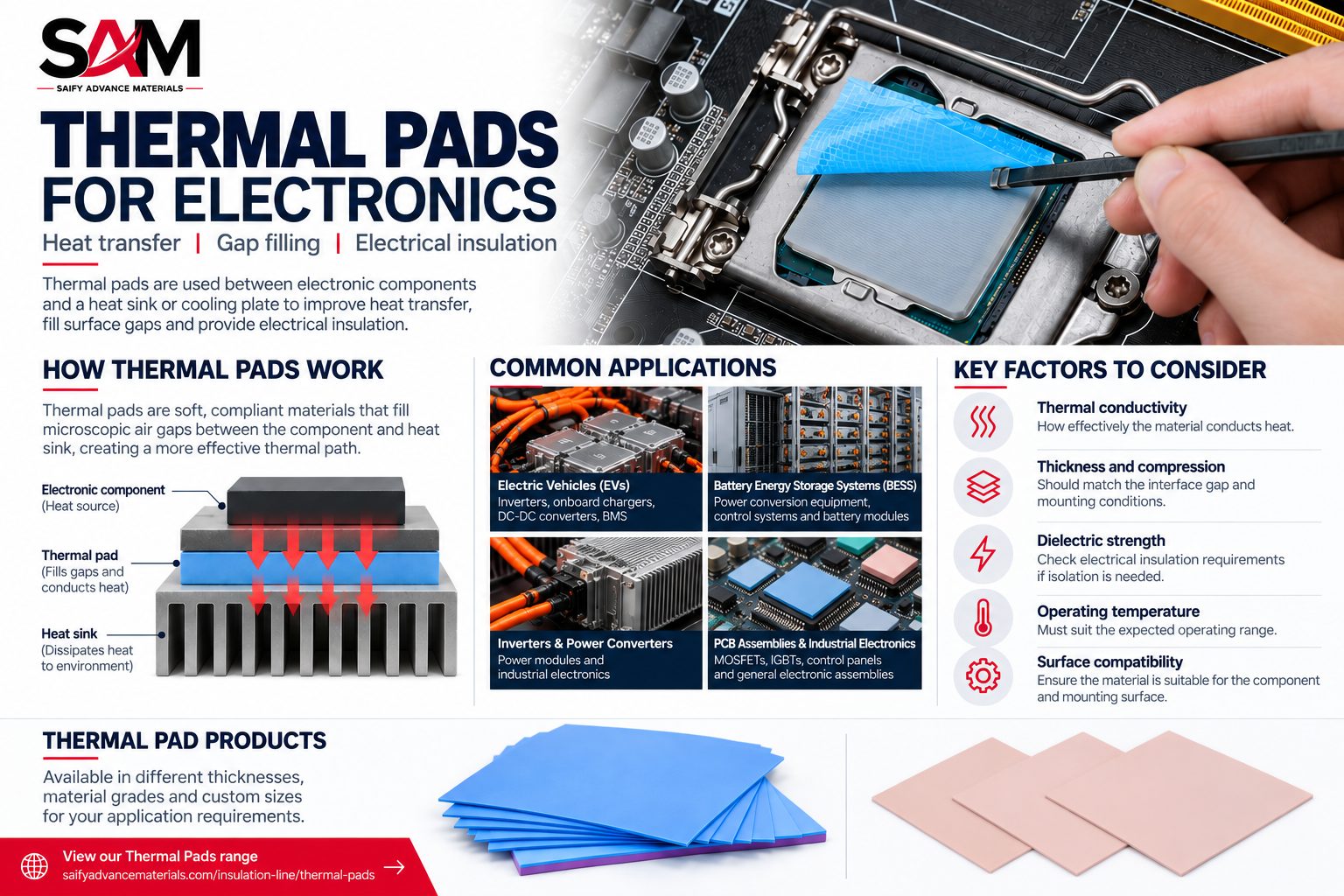
What Are Thermal Pads and Why Are They Used?
Heat management is an important part of designing electrical and electronic equipment. Components such as power modules, MOSFETs, IGBTs, inverters and battery systems generate heat during operation. If this heat is not managed properly, it can affect performance, reliability and the service life of the equipment.
One of the challenges is transferring heat from a component to a heat sink or cooling plate. Even when two surfaces appear flat, small gaps can remain between them. These gaps trap air, which does not conduct heat as effectively as most solid thermal interface materials.
This is where thermal pads are used.
Thermal pads are materials placed between two surfaces to improve heat transfer. They fill small gaps, improve contact between components and cooling structures, and help reduce thermal resistance at the interface.
Depending on the material grade, thermal pads can also provide electrical insulation and accommodate variations in component height.
At Saify Advance Materials, we supply insulation materials for industrial and electrical applications, including thermal interface materials for suitable applications. If you're looking for thermal pads, you can explore our Thermal Pads product page for more information.
How Do Thermal Pads Work?
A thermal pad creates a thermal connection between a heat-generating component and a surface that can absorb or dissipate that heat.
The pad fills gaps between the two surfaces, reducing the amount of trapped air and improving contact. Heat can then pass through the material and into the connected cooling structure.
The performance of a thermal pad depends on a few important factors:
- Thermal conductivity: How effectively the material conducts heat.
- Thickness: The distance heat must travel through the pad.
- Contact quality: How well the pad conforms to the surfaces.
- Compression: Whether the material can accommodate the gap without excessive mounting pressure.
- Electrical properties: Whether the application requires insulation between the component and the cooling structure.
Choosing a pad based on thermal conductivity alone is not enough. The material must suit the actual assembly and its operating conditions.
For manufacturers evaluating thermal interface materials, Saify Advance Materials can be a starting point for exploring suitable material options. You can also visit our thermal pads range.
Key Benefits of Thermal Pads
1. Better Heat Transfer
Thermal pads fill surface irregularities and reduce air gaps between components. This helps improve heat transfer to heat sinks, cold plates and other cooling structures.
The improvement depends on the material selected and the design of the complete thermal path.
2. Electrical Insulation
Some thermal pads are designed to conduct heat while electrically isolating the component from a conductive surface.
This is useful in power electronics, where components may need to transfer heat to a metal heat sink without creating an unwanted electrical connection.
The required dielectric strength and insulation performance should be checked against the application's specifications.
3. Filling Gaps Between Components
Manufacturing tolerances can create gaps between electronic components and cooling surfaces. Thermal pads are available in different thicknesses and compression levels to accommodate these differences.
Selecting the right thickness is important. A pad that is too thin may not make proper contact, while excessive thickness or compression can affect thermal performance and put unnecessary stress on components.
4. Easier Assembly
Thermal pads are supplied in preformed sheets or specific shapes, making them easier to position during assembly than materials that need to be applied as a paste.
For manufacturers, custom-cut pads can also help maintain consistent placement across production runs.
Depending on the application and material requirements, Saify Advance Materials can help customers explore suitable insulation material options for their assemblies.
Applications of Thermal Pads
Thermal pads are used across several industries where heat needs to be transferred between components and cooling structures.
Thermal Pads for Electric Vehicles (EVs)
Electric vehicles use power electronics throughout the vehicle, including traction inverters, onboard chargers, DC-DC converters and battery management systems.
Many of these components generate heat and require effective thermal management.
Thermal pads can be used between suitable electronic components and heat sinks or cooling plates to improve heat transfer. In battery-related applications, thermal interface materials may also be used between selected components and designated thermal management structures.
The material must be selected based on the required thermal performance, electrical insulation, temperature range, vibration resistance and mechanical conditions.
For EV manufacturers and suppliers looking for insulation materials, Saify Advance Materials provides a range of industrial insulation products. Visit our thermal pads product page to explore the relevant material category.
Thermal Pads for Battery Energy Storage Systems (BESS)
Battery energy storage systems contain battery modules, power conversion equipment, inverters and electronic control systems. Managing operating temperatures is important for system performance and reliability.
Thermal pads can be used in selected interfaces within power electronics and control equipment to transfer heat to cooling structures.
For BESS applications, factors such as operating temperature, interface thickness, compression, electrical insulation and long-term material stability should be considered.
Thermal pads are only one part of the overall thermal management system. Battery cooling and temperature control depend on the complete system design.
Thermal Pads for Inverters and Power Converters
Inverters and power converters use semiconductor devices to convert and control electrical power. These devices can generate significant heat, particularly under high-load conditions.
Thermal pads help transfer heat from suitable power components to heat sinks or cold plates.
The correct material depends on the component design, heat load, available mounting pressure and electrical isolation requirements.
Saify Advance Materials works with industrial customers sourcing insulation materials for electrical applications. Our thermal pads range is a useful starting point when evaluating material requirements for power electronics.
Thermal Pads for MOSFETs and IGBTs
MOSFETs and IGBTs are commonly used in motor drives, industrial power supplies, EV inverters and other power electronics.
Thermal pads can be installed between compatible semiconductor packages and heat sinks to improve heat transfer.
When selecting a pad, engineers should consider thermal resistance, dielectric strength, thickness and the mounting arrangement. A material with high thermal conductivity may not be suitable if it cannot accommodate the available gap or requires excessive mounting pressure.
Thermal Pads for PCB Assemblies and Industrial Electronics
Electronic assemblies often contain processors, power components and other devices that generate heat during operation.
Thermal pads can connect these components to metal enclosures, heat spreaders or dedicated cooling structures.
They are also used in applications such as industrial control panels, motor drives, communication equipment and power supplies.
The main consideration is whether the pad can provide a suitable thermal connection without affecting the electrical or mechanical requirements of the assembly.
How to Choose the Right Thermal Pad
Different applications require different material properties. Before selecting a thermal pad, it is worth checking the following specifications.
Thermal Conductivity
Thermal conductivity is measured in watts per metre-kelvin (W/m·K). It indicates how effectively a material conducts heat.
A higher value can be beneficial, but it does not automatically mean better performance in every application. Thickness, contact resistance and mounting conditions also affect the result.
Thickness
The thickness should match the gap between the two surfaces, including manufacturing tolerances.
A pad that is too thin may leave gaps, while an unnecessarily thick pad can increase thermal resistance. The manufacturer's recommended compression range should also be considered.
Compressibility
Compressibility determines how well a pad conforms to the surfaces when pressure is applied.
Softer materials may be useful for uneven surfaces or assemblies with varying gaps. However, the material must be compatible with the mounting pressure and the mechanical strength of the components.
Dielectric Strength
If electrical insulation is required, check the pad's dielectric strength and other relevant electrical properties.
Do not assume that every thermal pad provides the same level of electrical insulation. The required specification depends on the voltage and safety requirements of the application.
Temperature Resistance
The material must remain suitable across the expected operating temperature range.
For EVs, BESS and industrial electronics, it is also worth considering thermal cycling, vibration, ageing and compression set, as these can affect long-term performance.
Size and Shape
Standard thermal pads may work for simple interfaces, but some assemblies require specific dimensions, mounting holes or cut-outs.
Custom die-cut pads can be made to suit the component layout and help simplify assembly. Providing a drawing or sample makes it easier to identify the required dimensions and tolerances.
If you're sourcing thermal pads for a specific application, you can review the thermal pads range from Saify Advance Materials and share your technical requirements with our team.
Thermal Pads vs Thermal Grease
Both thermal pads and thermal grease are used to improve heat transfer between surfaces, but they suit different applications.
| Feature | Thermal Pads | Thermal Grease |
|---|---|---|
| Form | Preformed solid or flexible material | Paste or compound |
| Application | Placed between two surfaces | Applied directly to a surface |
| Gap filling | Available in different thicknesses to bridge gaps | Generally suited to thinner interfaces |
| Handling | Easier to position | Requires controlled application |
| Electrical insulation | Available in insulating grades | Depends on formulation |
| Common consideration | Thickness and compression | Applied quantity and layer thickness |
Thermal pads are often useful when the gap needs to be filled with a material of defined thickness or when consistent placement is important.
Thermal grease can be suitable for thin interfaces where the mating surfaces fit closely together.
The better option depends on the component design, thermal requirements and assembly process.
Why Custom Die-Cut Thermal Pads Are Useful
In many industrial applications, the pad needs to match the component rather than simply cover a flat area.
Custom die-cut thermal pads can be made to specific dimensions, with cut-outs for mounting holes, connectors or other components.
This helps manufacturers achieve a better fit and makes the material easier to position during assembly.
When sourcing custom thermal pads, it is useful to provide:
- Required dimensions: Length, width and thickness.
- Technical drawing or sample: To confirm the required shape and fit.
- Application details: The component and cooling surface between which the pad will be installed.
- Thermal and electrical requirements: Thermal conductivity and dielectric specifications.
- Operating conditions: Temperature and compression requirements.
- Quantity and tolerances: Expected order quantity and dimensional tolerances.
These details help narrow down the material options and avoid selecting a grade that does not suit the application.
For enquiries about thermal pads and other insulation materials, contact Saify Advance Materials through our thermal pads product page.
Common Mistakes When Selecting Thermal Pads
A few common mistakes can affect thermal performance and reliability.
- Choosing only by thermal conductivity: A higher rating does not guarantee better performance once the pad is installed.
- Ignoring thickness: The pad must suit the actual gap and recommended compression range.
- Overlooking electrical insulation: Dielectric properties need to be checked wherever the pad must isolate a component from a conductive surface.
- Using excessive mounting pressure: Too much pressure can damage sensitive components or affect the interface.
- Ignoring operating conditions: Temperature changes, vibration and long-term compression can affect material performance.
- Expecting the pad to solve every cooling problem: The pad improves the interface, but the heat must still be carried away by the wider cooling system.
Sourcing Thermal Pads from Saify Advance Materials
At Saify Advance Materials, we supply insulation materials for industrial and electrical applications. We understand that material requirements can vary depending on the equipment, component design and operating conditions.
Thermal pad requirements can differ significantly between an EV inverter, BESS equipment, a power converter and a general electronic assembly.
The right starting point is to understand the application, required dimensions and technical specifications rather than choosing a material based on a single property.
If you're looking for thermal pads, visit our Thermal Pads product page to explore the product category.
For application-specific enquiries, share your required dimensions, technical drawing or material specifications with our team.
You can also visit the Saify Advance Materials website to explore our insulation material range.
Frequently Asked Questions
What are thermal pads used for?
Thermal pads improve heat transfer between electronic components and cooling structures. Depending on the grade, they can also provide electrical insulation and fill gaps between surfaces.
Are thermal pads used in EVs?
Yes. Thermal interface materials are used in suitable EV applications, including power electronics and selected battery-related interfaces. The required material depends on the component design and thermal management system.
Can thermal pads be used in BESS?
Yes. They can be used in selected interfaces within BESS equipment, particularly power electronics and control assemblies. Material selection depends on the system's thermal, electrical and mechanical requirements.
Do thermal pads provide electrical insulation?
Some grades are designed to provide both thermal conductivity and electrical insulation. Always check the dielectric specifications before using a pad in an electrically sensitive application.
Is a higher thermal conductivity rating always better?
No. Thickness, contact quality, compression and the complete thermal path also affect performance. The material needs to suit the actual application.
Can thermal pads be cut to custom sizes?
Many thermal pad materials can be supplied in custom-cut or die-cut shapes, depending on the material and processing requirements.
How do I select the right thermal pad?
Start with the interface gap, required thermal performance, electrical insulation needs, operating temperature and available mounting pressure. A technical drawing or sample can help establish the appropriate dimensions and material requirements.
Where can I find thermal pads from Saify Advance Materials?
You can visit our Thermal Pads product page to explore the product category and contact our team with your requirements.
Conclusion
Thermal pads are an important part of heat management in EVs, BESS, inverters, power electronics and industrial equipment.
The right material helps improve heat transfer between components and cooling structures while meeting the application's electrical and mechanical requirements.
When selecting a thermal pad, look beyond thermal conductivity. Thickness, compressibility, dielectric strength and operating conditions all matter.
Saify Advance Materials helps industrial customers source insulation materials for different electrical applications. If you need thermal pads for your equipment or assembly, visit our thermal pads product page and share your requirements with our team.