
9 November 2026 · Saify Advance Materials
Transformer Insulation Materials: Types, Applications & Sourcing Guide
A practical guide to electrical insulation materials used in transformer manufacturing. Explore FR4, G10, G11, GPO-3, transformer pressboard, DMD, NMN, aramid papers, tapes, films and more, including their applications and sourcing options for manufacturers and fabricators across South India.
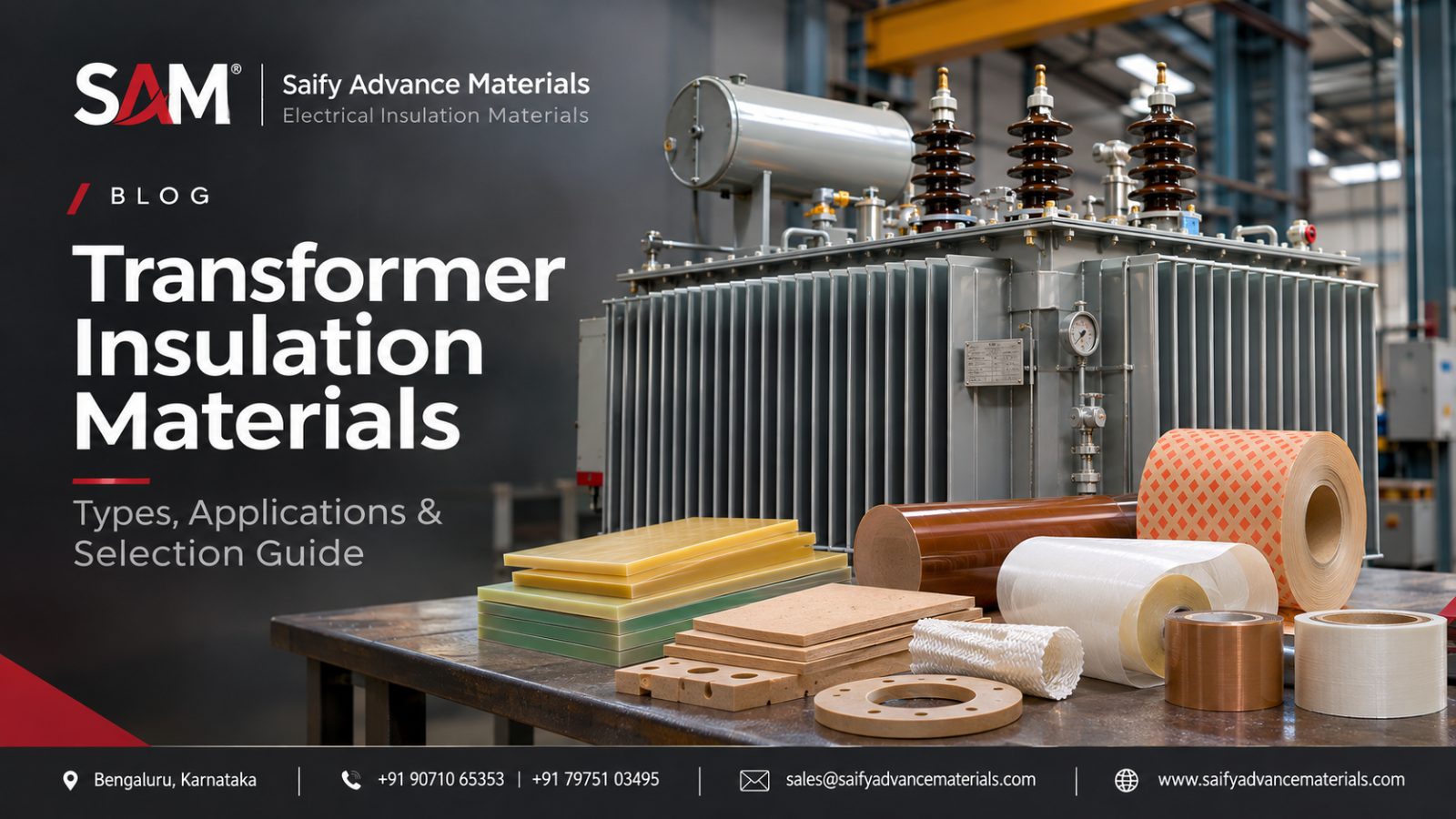
Transformer manufacturing involves several different insulation materials, each serving a specific purpose. From rigid insulation sheets and pressboard to flexible laminates, insulation papers, tapes and protective sleeves, choosing the right material is an important part of building a reliable transformer.
The requirements can vary depending on the transformer design, operating temperature, electrical specifications and the component being manufactured.
For transformer manufacturers and fabricators, sourcing these materials in the correct grade, thickness and dimensions is just as important as selecting the right product.
Some of the commonly specified materials include FR4 and G10 glass epoxy sheets, G11, GPO-3, electrical insulation pressboard, DMD and NMN laminates, aramid paper, diamond dotted paper, fibreglass tapes and insulation sleeves.
In this guide, we cover the different insulation materials used in transformer manufacturing, where they are used and what manufacturers should consider when sourcing them.
Saify Advance Materials is a Bengaluru-based supplier of electrical insulation materials, supporting transformer manufacturers, electrical fabricators and industrial buyers across Karnataka and South India.
1. FR4, G10 and G11 Glass Epoxy Sheets
Glass epoxy sheets are rigid composite materials manufactured by combining woven glass fibre fabric with epoxy resin. They are widely used in electrical and industrial applications because of their electrical insulation properties, mechanical strength and dimensional stability.
FR4, G10 and G11 are different grades of glass epoxy laminates, each with its own material specifications and intended applications.
For transformer manufacturers and fabricators, these sheets can be used for rigid insulating components, support plates and machined electrical insulation parts.
Where are glass epoxy sheets used?
Depending on the grade and component design, applications include:
- Rigid electrical insulation plates.
- Insulating support components.
- Separator and mounting plates.
- Custom-machined insulation components.
- Structural electrical insulation parts.
- Components requiring mechanical strength and electrical isolation.
FR4 Glass Epoxy Sheets
FR4 is a flame-retardant glass epoxy laminate used in electrical and industrial applications.
It is commonly selected for components requiring mechanical strength, electrical insulation and specified flame-retardant properties.
G10 Glass Epoxy Sheets
G10 is a glass-fibre-reinforced epoxy laminate known for its mechanical strength, electrical insulation properties and dimensional stability.
It is used in rigid insulating components and machined electrical parts.
G11 Glass Epoxy Sheets
G11 is a high-temperature glass epoxy laminate used in applications requiring greater thermal capability than conventional G10 grades.
It can be considered for electrical insulation components exposed to higher operating temperatures, subject to the material grade and engineering requirements.
For a more detailed comparison, read our existing article:
FR4 vs G10 Glass Epoxy Sheets: Key Differences
At Saify Advance Materials, we supply FR4 and G10 Glass Epoxy Sheets in different thicknesses and dimensions. Cut-to-size requirements can also be discussed with our team.
2. GPO-3 Glass Polyester Sheets
GPO-3 is a glass-fibre-reinforced polyester laminate designed for electrical insulation applications.
It is known for its electrical insulating properties, arc resistance, flame-retardant characteristics and mechanical strength, depending on the specified grade.
GPO-3 is particularly relevant to electrical equipment manufacturers, switchgear manufacturers and control panel fabricators.
Applications of GPO-3
Common applications include:
- Busbar support components.
- Electrical insulation barriers.
- Circuit breaker components.
- Switchgear insulation plates.
- Terminal boards and mounting components.
- Electrical panel fabrication.
For transformer manufacturers, GPO-3 may be required for associated switchgear, distribution panels and other electrical assemblies.
The material should be selected according to the electrical, thermal and mechanical requirements of the component.
Saify Advance Materials supplies GPO-3 Glass Polyester Sheets in different thicknesses and dimensions for industrial requirements.
3. Electrical Insulation Pressboard
Electrical insulation pressboard is one of the established cellulose-based materials used in transformer insulation systems, particularly in oil-filled transformers.
Manufactured from cellulose fibres, pressboard is used to create insulating barriers, spacers and structural components within transformer assemblies.
It is an important material in oil-paper insulation systems, where its electrical and mechanical properties contribute to the overall insulation arrangement.
Where is transformer pressboard used?
Common applications include:
- Transformer insulation barriers.
- Axial and radial spacers.
- Insulating cylinders.
- Winding support structures.
- Insulation components between different sections of an assembly.
- Fabricated transformer insulation parts.
Pressboard is available in different grades and thicknesses depending on the intended application.
What should you consider when buying pressboard?
Before placing an order, manufacturers should specify:
- Required pressboard grade.
- Thickness and sheet dimensions.
- Density and applicable material standard.
- Component dimensions, where applicable.
- Required quantity.
- Intended application.
Moisture control and drying are particularly important in oil-paper insulation systems, as the moisture condition of cellulose materials affects insulation performance.
Saify Advance Materials supplies Electrical Insulation Pressboard for transformer manufacturing and other industrial electrical applications.
4. DMD, NMN and AMA Electrical Insulation Laminates
Flexible electrical insulation laminates are used where materials need to conform to winding structures, separate electrical components or provide insulation between layers.
These materials combine different films and insulation papers to achieve specific electrical, thermal and mechanical properties.
Some commonly specified laminate types include DMD, NMN and AMA.
DMD Laminates
DMD is a three-layer flexible electrical insulation laminate consisting of non-woven polyester, polyester film and another layer of non-woven polyester.
It combines flexibility with the dielectric and mechanical properties required in electrical insulation applications.
Common applications include:
- Interlayer insulation.
- Winding insulation.
- Electrical separation between components.
- Flexible insulation barriers.
- Selected dry-type transformer applications.
NMN Laminates
NMN consists of Nomex paper, polyester film and another layer of Nomex paper.
It combines the flexibility and thermal characteristics of aramid paper with the properties of a polyester film layer.
Applications can include:
- Winding insulation.
- Interlayer insulation.
- Phase separation.
- Electrical insulation in specified dry-type transformer systems.
AMA Laminates
AMA is a flexible composite insulation laminate incorporating aramid paper and polyester film layers.
It is used in selected electrical insulation systems where flexibility, thermal endurance and dielectric performance are required.
The actual construction and thermal class should always be verified against the datasheet for the specified grade.
For manufacturers and fabricators, the important purchasing specifications include laminate type, thickness, width, roll or sheet form and thermal requirements.
Explore our range of DMD, NMN and AMA Electrical Insulation Laminates.
5. Aramid Paper, Nomex and Other Transformer Insulation Papers
Electrical insulation papers are an important part of transformer manufacturing, particularly in applications involving winding insulation, conductor insulation and electrical separation.
Different paper grades are available depending on the required thermal, dielectric and mechanical properties.
Pure Aramid Paper
Aramid paper is a high-performance electrical insulation material manufactured from aromatic polyamide fibres.
It is valued for its thermal endurance, dielectric properties and mechanical characteristics.
Depending on the grade, applications include:
- Conductor insulation.
- Winding insulation.
- Coil-end insulation and filling.
- Electrical barriers.
- Insulation between selected components.
Nomex Paper
Nomex® is a recognised commercial family of aramid-based insulation papers.
Specific grades are used in transformer and electrical equipment insulation systems where higher thermal endurance is required.
The grade should be selected according to the intended application, temperature requirements and insulation system.
Diamond Dotted Paper
Diamond dotted paper is a cellulose-based electrical insulation paper coated with thermosetting resin in a diamond pattern.
It is used in selected transformer winding insulation systems where the resin coating provides bonding between layers during the specified manufacturing and curing process.
Crepe Paper
Crepe paper has a crinkled structure that gives it additional flexibility and conformability.
It is used in transformer insulation applications requiring wrapping around conductors, leads and irregular profiles.
Fish Paper (Barley Paper)
Fish paper, also known as vulcanised fibre paper, is a cellulose-based electrical insulation material.
It is used in electrical components requiring thin, flexible insulating barriers and separators, subject to the specified grade.
Explore our range of Electrical Insulation Papers, including pure aramid paper, Nomex paper, diamond dotted paper, crepe paper and fish paper.
6. Electrical Insulation Tapes and Cross-Filament Tape
Tapes are used in electrical manufacturing for wrapping, insulation, binding, reinforcement and securing different components.
Different tape constructions are available depending on the application, backing material, adhesive system and operating environment.
Non-Adhesive Fibreglass Tape
Non-adhesive fibreglass tape is manufactured using woven glass fibre yarns.
It is used in electrical and thermal insulation applications where a flexible tape is required for wrapping, banding or reinforcing components without an adhesive layer.
Applications include:
- Transformer winding and insulation.
- Motor and generator coil wrapping.
- Electrical component reinforcement.
- Cable and wire harness insulation.
- Thermal insulation wrapping.
Polyimide Tape
Polyimide tape consists of polyimide film coated with an adhesive, commonly silicone-based.
It is used in electrical and industrial applications requiring thermal stability and dielectric insulation.
Applications include:
- Electrical component insulation.
- Coil wrapping.
- High-temperature masking.
- Surface protection during manufacturing.
- Selected transformer and motor insulation applications.
PTFE Tape
PTFE tape is manufactured using polytetrafluoroethylene and is valued for its thermal characteristics, chemical resistance and electrical properties.
It is used in selected industrial and electrical applications where these material characteristics are required.
Cross-Filament Tape
Cross-filament tape is a reinforced adhesive tape incorporating glass fibre filaments in longitudinal and crosswise directions.
Its main purpose is reinforcement and securing rather than primary dielectric insulation.
Applications include:
- Bundling and securing insulation material packs.
- Holding components during handling and transportation.
- Reinforcing industrial packaging.
- Securing heavy-duty material bundles.
For transformer manufacturers and fabricators handling large insulation sheets, rolls and fabricated components, cross-filament tape can be useful for material bundling and handling requirements.
For actual electrical insulation applications, the appropriate fibreglass, polyimide or PTFE tape should be selected according to the component specification.
Explore our Electrical Insulation Tapes and contact our team for cross-filament tape requirements.
7. Fibreglass Sleeves, WOER Heat Shrink Sleeves and Insulation Fabrics
Insulation sleeves are used in electrical equipment manufacturing to protect wires, conductors, terminals and connections from electrical contact, abrasion and environmental exposure.
Different sleeve constructions are available depending on operating temperature, voltage requirements, mechanical protection and the application.
Silicone-Coated Fibreglass Sleeves
Silicone-coated fibreglass sleeves are manufactured using braided fibreglass yarn coated with silicone rubber.
They provide flexible electrical insulation and mechanical protection for conductors operating in demanding thermal environments.
Applications include:
- Transformer lead and connection insulation.
- Motor and generator wiring protection.
- Electrical cable and conductor insulation.
- Switchgear and control panel wiring.
- High-temperature electrical assemblies.
WOER Heat Shrink Sleeves
WOER heat shrink tubing is used in electrical insulation and cable protection applications.
When exposed to controlled heat, the tubing contracts around the component to provide a close-fitting protective covering.
Depending on the specified product grade, applications include:
- Insulation of wire connections and cable joints.
- Terminal and connector protection.
- Electrical harness bundling.
- Protection of selected busbar connections.
- Electrical equipment and panel assemblies.
The appropriate sleeve should be selected based on its material construction, shrink ratio, recovered diameter, wall thickness and operating temperature.
For transformer manufacturers and electrical fabricators, heat shrink sleeves can be useful for protecting auxiliary wiring, terminals and electrical connections within associated assemblies.
PVC Heat Shrink Sleeves
PVC heat shrink sleeves provide electrical insulation and mechanical protection for wires, terminals and selected electrical components.
They are also used in battery packs, battery modules and energy storage assemblies.
PTFE-Coated Fibreglass Cloth
PTFE-coated fibreglass cloth combines woven glass fibre reinforcement with a PTFE coating.
It is used in selected industrial applications requiring thermal resistance, chemical resistance and a non-stick surface.
Explore our Electrical Insulation Sleeves and Insulation Fabrics.
8. Polyimide Films and PEEK Films
Flexible insulation films are used in electrical and industrial applications where thin, flexible materials with specific thermal and dielectric properties are required.
Polyimide Films
Polyimide film is a high-performance electrical insulation material known for its thermal stability, dielectric properties and chemical resistance.
Depending on the grade and insulation system, applications include:
- Flexible electrical insulation.
- Coil and wire wrapping.
- Thin insulating barriers.
- Electrical component insulation.
- Selected high-temperature applications.
PEEK Films
PEEK film is a high-performance thermoplastic film used in specialised electrical and industrial applications.
It offers a combination of thermal stability, mechanical performance and electrical insulation properties.
Its suitability should be evaluated against the exact application and insulation system rather than treated as a direct replacement for conventional transformer insulation materials.
Explore our Polyimide and PEEK Insulation Films.
9. Hylam, Copper Clad Laminates and Other Insulation Sheets
Apart from glass epoxy sheets, transformer manufacturers and associated electrical fabricators may require other rigid sheet materials for specific mechanical and electrical components.
Mechanical Grade Hylam Sheets
Hylam sheets are phenolic resin-bonded laminates manufactured using paper or cotton fabric.
Mechanical-grade Hylam is valued for its mechanical strength, wear resistance and machinability.
Potential applications in industrial fabrication include:
- Machined insulating components.
- Bushes and washers.
- Spacers and support parts.
- Mechanical components in electrical equipment.
The exact grade should be selected according to the electrical and mechanical requirements. Mechanical-grade Hylam should not automatically be treated as a substitute for a specified electrical-grade laminate.
Copper Clad Laminate Sheets (CCL)
Copper clad laminates consist of copper foil bonded to an insulating substrate.
They are primarily used in printed circuit board manufacturing and electronic control assemblies.
For transformer manufacturers, these materials may be relevant to associated electronic control or monitoring assemblies rather than the main transformer winding insulation system.
Metal Core Printed Circuit Board (MCPCB) Sheets
MCPCB sheets are metal-core printed circuit board materials designed for electronic assemblies requiring heat dissipation.
They may be relevant to auxiliary electronic control systems and power electronics associated with electrical equipment, rather than conventional transformer insulation structures.
Explore our Electrical Insulation Sheets.
10. SMC Sheets and Thermal Pads for Associated Electrical Equipment
Apart from conventional transformer winding insulation materials, manufacturers and fabricators also require specialised materials for electrical enclosures, control panels, power distribution equipment and auxiliary electronic assemblies.
Two relevant product categories are SMC sheets and thermal interface pads.
Sintex SMC Sheets
SMC, or Sheet Moulding Compound, is a fibre-reinforced thermosetting composite material.
It is used in electrical and industrial applications requiring mechanical strength, dimensional stability and resistance to moisture and corrosion, depending on the specified grade.
Applications include:
- Electrical enclosures.
- Switchgear and control panel components.
- Power distribution equipment.
- Electrical insulation structures.
- Industrial electrical assemblies.
- Renewable energy and EV charging infrastructure.
For transformer manufacturers and fabricators, SMC sheets can be considered for associated electrical enclosures, panel assemblies and distribution equipment.
The material grade and thickness should be selected according to the component design and relevant electrical and mechanical requirements.
Saify Advance Materials supplies Sintex SMC Sheets for industrial and electrical manufacturing requirements.
Thermal Pads
Thermal pads are thermally conductive interface materials designed to transfer heat between electronic components and heat sinks or cooling surfaces.
They are generally used where an interface material is needed to bridge small gaps between components and improve heat transfer.
Applications include:
- Power electronics.
- Battery management systems.
- EV battery assemblies.
- Battery Energy Storage Systems (BESS).
- Inverters and converters.
- Electronic control and monitoring assemblies.
- LED and industrial electronic systems.
For transformer manufacturers, thermal pads may be relevant to auxiliary electronic equipment, control boards, monitoring systems and associated power electronics where thermal management is required.
They should not be confused with conventional dielectric winding insulation materials. Their suitability depends on thermal conductivity, electrical insulation requirements, thickness and operating conditions.
Saify Advance Materials supplies Thermal Pads for EV, BESS, power electronics and industrial applications.
11. How to Select the Right Insulation Material for Transformer Manufacturing
Choosing a transformer insulation material involves more than comparing prices or selecting a material based on its general properties.
The correct material depends on where it will be used and the electrical, mechanical and environmental conditions it will experience.
Before placing an order, manufacturers and fabricators should consider the following factors.
1. Electrical requirements
The material must meet the electrical requirements of the specific component, including dielectric properties and intended operating conditions.
2. Operating temperature
Different insulation materials and grades have different thermal capabilities. The selected material must be compatible with the operating temperature and the overall insulation system.
3. Mechanical requirements
Rigid laminates, pressboard and flexible papers perform different functions. Consider whether the component requires structural support, flexibility, compression resistance or conformability.
4. Transformer type
Oil-filled and dry-type transformers have different insulation system requirements.
Materials must be selected according to the transformer design and compatibility with the relevant insulating environment.
5. Thickness and dimensions
Thickness, sheet size, roll width and finished component dimensions should be clearly specified before procurement.
6. Material grade and documentation
Always request the relevant technical datasheet and verify that the material meets the manufacturer's or customer's engineering specification.
For repeat production requirements, maintaining consistent material grades and specifications also helps streamline procurement.
12. Sourcing Transformer Insulation Materials in Bengaluru and South India
For transformer manufacturers and fabricators, sourcing multiple insulation materials through a dependable supplier can simplify procurement and production planning.
A manufacturing requirement may involve rigid epoxy sheets for fabricated components, pressboard for transformer insulation structures, flexible laminates for winding applications, insulation papers and tapes for electrical separation, and sleeves for conductor protection.
Working with a supplier that offers multiple insulation product categories makes it easier to consolidate material enquiries and source products according to project requirements.
Electrical Insulation Materials Supplier in Bengaluru
Saify Advance Materials is based in Bengaluru, Karnataka, and supplies electrical insulation materials and engineered products for industrial requirements.
We work with OEMs, transformer manufacturers, electrical fabricators and component manufacturers looking for materials in specific grades, thicknesses, dimensions and quantities.
Our product range includes:
- FR4, G10 and G11 glass epoxy sheets.
- GPO-3 glass polyester sheets.
- Electrical insulation pressboard.
- DMD, NMN and AMA laminates.
- Pure aramid paper and Nomex paper.
- Diamond dotted paper and crepe paper.
- Fish paper.
- Fibreglass, polyimide and PTFE tapes.
- Cross-filament tape.
- Silicone-coated fibreglass sleeves.
- PVC and WOER heat shrink sleeves.
- Polyimide and PEEK films.
- PTFE-coated fibreglass fabrics.
- Mechanical-grade Hylam sheets.
- Copper clad and MCPCB sheets.
- Sintex SMC sheets.
- Thermal pads.
Supplying Transformer Manufacturers Across South India
From our Bengaluru base, we support enquiries from industrial buyers and manufacturers across Karnataka, Tamil Nadu, Kerala, Telangana and Andhra Pradesh.
We also cater to requirements from important industrial locations such as:
- Bengaluru and surrounding industrial areas.
- Hosur and Chennai.
- Coimbatore and other Tamil Nadu manufacturing centres.
- Hyderabad and Telangana.
- Kochi and other industrial areas in Kerala.
- Industrial locations across Andhra Pradesh.
For manufacturers with recurring requirements, having access to multiple insulation product categories through one supplier can help simplify procurement and material sourcing.
Whether you require full sheets, rolls, specific thicknesses, cut-to-size materials or machined components based on drawings, our team can assist with product enquiries and quotations, subject to specifications and availability.
Explore our complete Electrical Insulation Materials Catalogue.
Frequently Asked Questions About Transformer Insulation Materials
1. What materials are commonly used in transformer manufacturing?
Commonly specified materials include transformer pressboard, aramid paper, Nomex, DMD and NMN laminates, diamond dotted paper, crepe paper and selected rigid insulation laminates such as FR4, G10 and G11. The choice depends on the transformer design and the component's requirements.
2. What is the difference between FR4, G10 and G11 sheets?
All three are glass-fibre-reinforced epoxy laminates. They differ in their specifications and thermal capabilities. FR4 has specified flame-retardant properties, G10 is commonly selected for its mechanical and electrical properties, while G11 is designed for applications requiring higher thermal capability. Always check the relevant grade datasheet.
3. What is GPO-3 used for in electrical applications?
GPO-3 is used in electrical insulation applications such as busbar supports, switchgear components, circuit breaker parts and insulation barriers. It is particularly relevant to power distribution equipment and electrical panel manufacturing.
4. Where is transformer pressboard used?
Transformer pressboard is commonly used in oil-filled transformer insulation systems. Applications include insulating barriers, spacers, cylinders and winding support components.
5. What are DMD and NMN insulation laminates?
DMD and NMN are flexible electrical insulation laminates. DMD combines non-woven polyester and polyester film, while NMN combines Nomex paper and polyester film. They are used in specified winding and interlayer insulation applications.
6. Where can I buy transformer insulation materials in Bengaluru?
Saify Advance Materials is a Bengaluru-based supplier of electrical insulation materials, including glass epoxy sheets, GPO-3, pressboard, flexible laminates, aramid papers, insulation tapes, films and sleeves.
Visit our insulation materials catalogue or contact our sales team for product enquiries.
7. Does Saify Advance Materials supply insulation materials across South India?
Yes. Saify Advance Materials supports industrial enquiries from Karnataka, Tamil Nadu, Kerala, Telangana and Andhra Pradesh, in addition to requirements from other parts of India.
8. Can insulation sheets be supplied in custom sizes?
Custom dimensions and cut-to-size requirements can be discussed with our team. Share the material grade, thickness, dimensions and quantity so that we can check feasibility and availability.
Looking for a Transformer Insulation Materials Supplier in South India?
Saify Advance Materials supplies electrical insulation materials for transformer manufacturers, fabricators and electrical component manufacturers.
From FR4, G10 and GPO-3 sheets to pressboard, flexible laminates, aramid papers, insulation tapes, films, sleeves, SMC sheets and thermal pads, we support a wide range of industrial material requirements.
If you are sourcing insulation materials for an upcoming transformer manufacturing or fabrication project, share your specifications with our team.
We can assist with enquiries involving different material grades, thicknesses, sheet dimensions, roll sizes and cut-to-size requirements.
Contact Saify Advance Materials
Saify Advance Materials (SAM)
Location: Bengaluru, Karnataka, India
Website: https://saifyadvancematerials.com/
Insulation Materials Catalogue: https://saifyadvancematerials.com/insulation-line
Email: sales@saifyadvancematerials.com
Phone: +91 90710 65353 / +91 79751 03495
For pricing, availability and lead time, send us your material specifications and quantity.